


Yah did not command parents to send their children somewhere to learn about Him. He commanded parents to become people who carry His words so deeply that those words naturally flow into every ordinary moment of life.
Entry #10 opened the Turah category with a commandment about honoring elders — the people in a community who carry what time and faithfulness have produced. It established that wisdom flows downward through generations, and that the failure to honor that flow breaks something that is difficult to restore.
Entry #11 takes that principle further and asks a more direct question: who is responsible for making sure the next generation actually receives what the previous one carried?
Yah answers that question in Deuteronomy 6:7. And His answer may surprise people who have grown accustomed to delegating the formation of children to institutions.
“You shall teach them diligently to your children, and shall talk of them when you sit in your house, when you walk by the way, when you lie down, and when you rise up.”
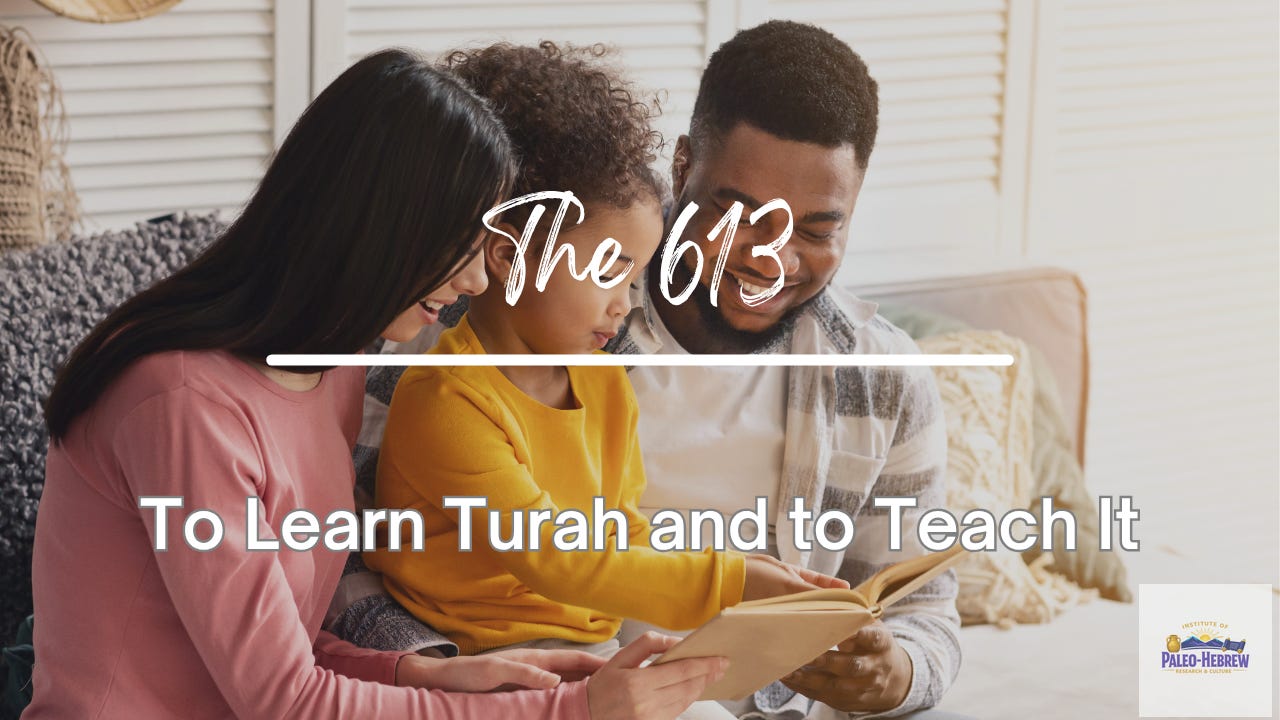
On the surface, this reads as a simple parenting instruction. Teach your children the Scriptures. Make time for it. Be intentional.
But Deuteronomy 6:7 is communicating something far larger than a curriculum recommendation. It is answering one of the most consequential questions any community can ask: who does Yah hold primarily responsible for forming the next generation?
And the answer, stated clearly throughout the full arc of Deuteronomy 6, is the household. Not the priest. Not the Levites. Not the king. Not a school, a mentor, a celebrity, an electronic device, or any outside institution. The household — the elders alongside the father and the mother — bears the primary responsibility.
To understand why Yah places that weight here, we have to sit with what the Paleo-Hebrew words are actually saying.
Scripture References
The anchor text:
“You shall teach them diligently to your children, and shall talk of them when you sit in your house, when you walk by the way, when you lie down, and when you rise up.” — Deuteronomy 6:7
This verse sits within a larger passage that cannot be separated from it:
“Hear, O Yasharaal: Yahauah our Alah, Yahauah is One. And you shall love Yahauah your alah with all your heart, with all your soul, and with all your might. And these words that I command you today shall be on your heart. You shall teach them diligently to your children...” — Deuteronomy 6:4–7
The sequence is the instruction. The prophetic writings reinforce that generational transmission was a covenant responsibility:
“We will not hide them from their children; we will tell the next generation the praiseworthy deeds of Yahauah, his power, and the wonders he has done.” — Psalm 78:4
“Even when I am old and gray, do not forsake me, my Alah, till I declare your power to the next generation, your mighty acts to all who are to come.” — Psalm 71:18
The wisdom writings show this as a multi-generational vision, not a single-generation responsibility:
“Train up a child in the way he should go; even when he is old he will not depart from it.” — Proverbs 22:6
The apostolic writings carry it forward:
“Fathers, do not provoke your children to anger, but bring them up in the discipline and instruction of Yahauah.” — Ephesians 6:4
Additional scriptures for self-study:
Deuteronomy 4:9–10
Deuteronomy 11:19–21
Deuteronomy 32:46
Joshua 4:21–24
Psalm 78:1–8
Proverbs 1:8–9
Isaiah 38:19
2 Timothy 3:14–15
Paleo-Hebrew Rendering & Meaning of Key Words
Deuteronomy 6:7
𐤅𐤔𐤍𐤍𐤕𐤌 𐤋𐤁𐤍𐤉𐤊 𐤅𐤃𐤁𐤓𐤕 𐤁𐤌 𐤁𐤔𐤁𐤕𐤊 𐤁𐤁𐤉𐤕𐤊 𐤅𐤁𐤋𐤊𐤕𐤊 𐤁𐤃𐤓𐤊 𐤅𐤁𐤔𐤊𐤁𐤊 𐤅𐤁𐤒𐤅𐤌𐤊
Three words carry the deepest weight of this commandment. Together they reframe the entire scene from a classroom image to something far more embedded in the fabric of daily life.
𐤅𐤃𐤁𐤓𐤕 — u’dabarat — from the root 𐤃𐤁𐤓 (dabar) — “to speak, declare, converse, command, promise, warn, threaten, sing, answer, appoint, bid, commune, declare, destroy, give; word, matter, thing, speech, command, promise, act, advice, affair, answer, book, business, pestilence, plague, murrain, a pasture, fold, manner”
Dabar is one of the most expansive words in the Paleo-Hebrew vocabulary. Most English translations render it simply as “talk” or “speak” in this verse — but that flattens what the word is actually carrying.
Notice the full range: dabar includes advice, command, business, pasture, and matter. Taken together, it describes speaking that has substance and purpose behind it. Not idle chatter. Not information dropped into a conversation. But the kind of deliberate, weighty communication that is offered as worthy to be followed — the definition of advice. That actively orders and enjoins — the definition of command. That reflects diligent occupation — the definition of business.
The image of pasture within dabar is particularly striking. A pasture is land covered with vegetation suitable for grazing — a feeding place. When parents dabar the words of Yah to their children, they are not filling out a lesson plan. They are feeding. They are providing sustenance that the child’s mind and spirit require in order to grow. The home becomes the pasture. The parent becomes the one who tends it.
𐤁𐤔𐤁𐤕𐤊 — ba’shabatak — from the root 𐤉𐤔𐤁 (yashab) — “to sit, dwell, remain, inhabit, make to abide, continue, cause to, make to dwelling, ease self, endure, establish, fail”
The deeper root shab (𐤔𐤁) carries the meanings of prison and captivity — which creates a striking picture: to sit in the home is not simply to be physically present. The home, in this framework, holds the family within its boundaries. It is the containing space — the enclosure — where formation happens precisely because the household is gathered within it.
The meanings “make to abide, remain, endure, establish” add further depth. The sitting spoken of in Deuteronomy 6:7 is not passive or incidental. It is intentional remaining — choosing to be present in the household, to be there in the ordinary moments, to not perpetually scatter outward so that no formation can take place in the home.
The teaching that happens while sitting is not structured or programmed. It is the natural overflow of a parent who is genuinely present — who has remained, who has established themselves in the household, and whose words flow into the space they share with their children.
𐤁𐤁𐤉𐤕𐤊 — ba’bayatak — from the root 𐤁𐤉𐤕 (bayat) — “house, household, temple, dwelling, court, door, dungeon, family, forth of, great as would contain, hangings, to pass the night”
Bayat is the word for house — but its range of meanings tells us that “house” in the Paleo-Hebrew world meant far more than a physical structure.
Household — members of a family collectively, including servants; furniture and articles belonging to a house; a dwelling, habitation; of or pertaining to house and family, domestic.
Temple — building for worship, edifice dedicated to the service of a deity; a piece of ground consecrated for the taking of auspices. The same word used for house is also the word used for temple. This is not incidental. The bayat — the household — was understood to be a sacred space. Not because of its architecture, but because of what happened within it.
Family — servants of a household; members of a household; the estate and property; the household including relatives and servants; parents with their children; collective body of persons who form one household under one head and one domestic government.
And perhaps most important for this commandment: “great as would contain.” The bayat is the space that holds everything within it. It is the containing environment — the vessel within which the most formative influences of a child’s life are concentrated.
The home, in Deuteronomy 6:7, is not merely where children sleep and eat before going out into the world. It is the temple — the consecrated space — where Yah intends formation to happen. It is designed to be great enough to contain what the next generation needs.
The Rhythm of the Verse
The four moments named in Deuteronomy 6:7 — sitting, walking, lying down, rising up — are not random. They cover the entire arc of a day. Morning and evening. Movement and rest. Public and private. The commandment is not describing a scheduled activity. It is describing a saturation — a way of life in which Yah’s words permeate every ordinary rhythm rather than being confined to a designated hour.
Ba’darakak — the word for “walking by the way” — carries the same root darak we encountered in Entry #9, where we saw it described as the manner of conducting oneself, the course of a life, the path of a journey. The teaching embedded in walking is not incidental. It is the formation that happens in motion — in the in-between moments, the transitions, the ordinary travels that constitute most of a life.
The Reason Behind the Commandment
The full arc of Deuteronomy 6 reveals something important about the order Yah intends. Before the commandment to teach the children appears, four prior instructions come first:
Hear — the people must receive the word. Love Yahauah — the people must be in right relationship. Let the words be upon your own heart — the people must have internalized what they are about to transmit. Then — and only then — teach them diligently to your children.
The sequence is the instruction. A parent cannot effectively transmit what they have not first received and internalized themselves. The commandment does not begin with the children. It begins with the parent. Yah first transforms the household head. The transformed household head shapes the home. The home shapes the children.
This is why the command is placed in the household rather than in the hands of priests, institutions, or any outside body. Priests and teachers and community leaders can supplement and reinforce. But the primary formation of covenant identity — the first and deepest shaping of who a child understands themselves to be in relation to Yah — was designed to happen at home, through the people the child lives with, trusts most, and watches most closely.
Children imitate before they understand. They absorb long before they analyze. The household is the environment that surrounds them during the years when they are most porous — most open to having a way of life formed in them rather than simply taught to them. That is why Yah places the primary responsibility there.
Practical Application
Six Ways Deuteronomy 6:7 Reshapes How We Think About Formation
1. Parents Were Intended to Be the Primary Disciplers
The parent cannot pass on what they have not first embraced. The order in Deuteronomy 6 makes this undeniable — hear, love, let the words be on your own heart — and only then teach the children.
This means the first work of covenant formation is not curriculum selection or scheduling. It is personal. It is the parent asking: Have these words settled on my own heart first? Because a father who tells his son “always tell the truth” while the son watches him lie every week is not transmitting truth. He is transmitting contradiction. Children are not primarily formed by what parents say. They are formed by what parents are.
Yah never commands: “Send your children somewhere else so they can know Me.” He transforms the parent. The parent shapes the home. The home shapes the children. That is the sequence — and reversing it does not produce the same result.
The question: Are the words of Yah on your own heart before you attempt to place them on your children’s?
2. Education Was a Way of Life, Not a Scheduled Activity
The four moments of Deuteronomy 6:7 — sitting, walking, lying down, rising up — cover an entire day without ever describing a classroom. Teaching happened while working, traveling, eating, farming, resting, and celebrating.
Life was the curriculum.
A father and daughter repairing a fence together are not only learning carpentry. They are learning patience. Responsibility. Integrity. Stewardship. Perseverance. The lesson is woven into the ordinary task. It does not require a lesson plan. It requires a parent who is present and paying attention to the formation happening in the in-between moments.
This reframes where formation actually occurs. Not in the scheduled hour but in the accumulated weight of thousands of ordinary moments — each one either reinforcing or contradicting what is being spoken.
The question: Are the ordinary moments of your household being used intentionally — or is formation being left to chance and the loudest competing influences?
3. The Home Was the First School
Languages are not first learned in schools. They are learned at home, before any formal instruction begins. Schools refine. Homes establish. The same principle is at work in Deuteronomy 6:7.
The covenant consistently places primary responsibility on the household — not because communities, teachers, and religious leaders have no role, but because their role is supplemental. They reinforce and extend what was intended to be established first at home. When the home fails to establish the foundation, external institutions are left trying to build on ground that was never prepared for them.
This is not a critique of teachers or community. It is a description of order. The household was designed to be the place where the deepest formation begins — where identity, character, and covenant relationship take root before anything else gets to influence them.
The question: Does your household function as the primary place where your children’s faith and character are being formed — or has that been delegated primarily to outside institutions?
4. Oral Teaching Required Living Examples
Because much of Turah instruction was transmitted orally — through stories, songs, blessings, prayers, and repeated commands — consistency was not optional. Children heard the same things repeatedly over years. But they also watched.
This meant that hypocrisy became immediately visible. A parent could not hand a child a book and walk away. The parent had to be the living embodiment of what they were transmitting. The teaching was not separate from the teacher. The teacher was the lesson.
This is the weight the dabar word carries — the kind of speaking that functions as business, as counsel offered as worthy to be followed, as pasture. It is not speaking that can be disconnected from the life of the one speaking. The words carry their authority from the life behind them.
The question: Does the life you are living reinforce what you are speaking — or does it work against it?
5. Faith Was Multi-Generational
Modern culture tends to think in individual terms: my faith, my relationship with the Creator, my spiritual journey. Deuteronomy 6 thinks differently. Every generation is responsible not only for knowing Yah themselves but for ensuring the next generation knows Him too.
The question is not only: Do I know Yah? It is also: Will my grandchildren know Yah because of how I lived?
The image of relay runners captures this well. Each generation receives the baton — the accumulated covenant knowledge of those who came before. The responsibility is not simply to hold it. It is to carry it faithfully and pass it intact to the next runner. A generation that drops the baton through neglect or distraction does not simply affect itself. It affects everyone who comes after.
The question: Are you carrying the covenant faithfully enough that the next generation will receive it from you — or will they have to find it for themselves, starting from zero?
6. Parents Were Forming Character, Not Simply Transferring Information
This may be the most overlooked dimension of Deuteronomy 6:7. The goal of the teaching was never simply for children to know the commandments. The goal was for children to become the kind of people who naturally walk in Yah’s ways.
There is a significant difference between those two outcomes.
Consider teaching a child to drive. You could give them the driver’s handbook and let them read it. Or you could spend years in the passenger seat — explaining decisions in real time, correcting mistakes as they happen, demonstrating patience in difficult conditions, modeling attentiveness when the road demands it. One transfers information. The other forms a driver.
Deuteronomy 6:7 is the second model. The goal is not a child who can recite the Turah. The goal is a child whose identity, character, habits, loves, and priorities have been shaped by living alongside people who have already been formed by it. The knowing and the becoming were intended to be inseparable.
The question: Are you investing in who your child is becoming — or only in what they know?
Closing Reflection
Deuteronomy 6:7 reveals that Yah never intended the home to be merely the place where children sleep, eat, and prepare to go out into the world.
He intended it to be the temple — the bayat, the sacred and containing space — where faith, wisdom, character, and covenant identity are formed from the inside out. Not by institution. Not by delegation. Not by curriculum alone. But by parents who have first allowed the words of Yah to settle on their own hearts, and who then speak those words — dabar, as counsel, as command, as pasture — into every sitting and every walking and every resting and every rising of ordinary life.
The rhythm of the verse is its own instruction. When you sit. When you walk. When you lie down. When you rise up. There is no moment outside of this. There is no time of day, no season of life, no ordinary task that falls outside the scope of what Yah intends parents to carry into their household.
Every conversation is formation. Every correction is formation. Every meal shared, every journey taken together, every ordinary moment in the bayat is either building the next generation’s understanding of who Yah is — or leaving that space to be filled by something else.
This is the weight of the commandment. Not as burden. As privilege.
You have been given the extraordinary assignment of being the primary person through whom the next generation first understands the character of the Most High. Not the priest. Not the school. Not the device. You — sitting in the household, walking by the way, lying down and rising up — have been placed first in the formation of the people who will carry the covenant after you are gone.
U’dabarat bam ba’shabatak ba’bayatak u’balakatak ba’darak uba’shakabak uba’qumak. — And you shall speak of them when you sit in your house, and when you walk by the way, and when you lie down, and when you rise up.
May what we carry be worthy of what we are passing on.
This article is part of the ongoing 613 Commandments series through the Institute of Paleo-Hebrew Research & Culture. For deeper study of the names, letters, and meanings referenced here, explore the Paleo-Hebrew Dictionary — a foundational resource for anyone who wants to understand Scripture from its ancient roots.